Fire Safety & Prevention
Most home fires are preventable — and most fire deaths happen where there is no working smoke alarm. A few simple habits protect your family and your neighbours: working alarms, a practised escape plan, and care in the kitchen and around open flame. The Bathurst Fire Department put this page together to help your household stay safe at home, outdoors, and in every season.
Get everyone out of the building first, then call from a safe place outside. Never go back inside.
Start here: four habits that save lives
Press the test button once a month, and replace any alarm more than 10 years old.
Know two ways out of every room and choose a meeting place outside.
Stay in the kitchen when you fry, grill or broil — most home fires start at the stove.
Keep an ABC extinguisher near an exit and learn to PASS before you ever need it.
Seasonal safety
When the weather turns warm, fire risk moves outdoors. The Bathurst Fire Department shares these seasonal reminders, produced by the New Brunswick Office of the Fire Marshal. Each poster can be saved, printed and shared.
Grilling season: turn up the flavour, not the fire risk
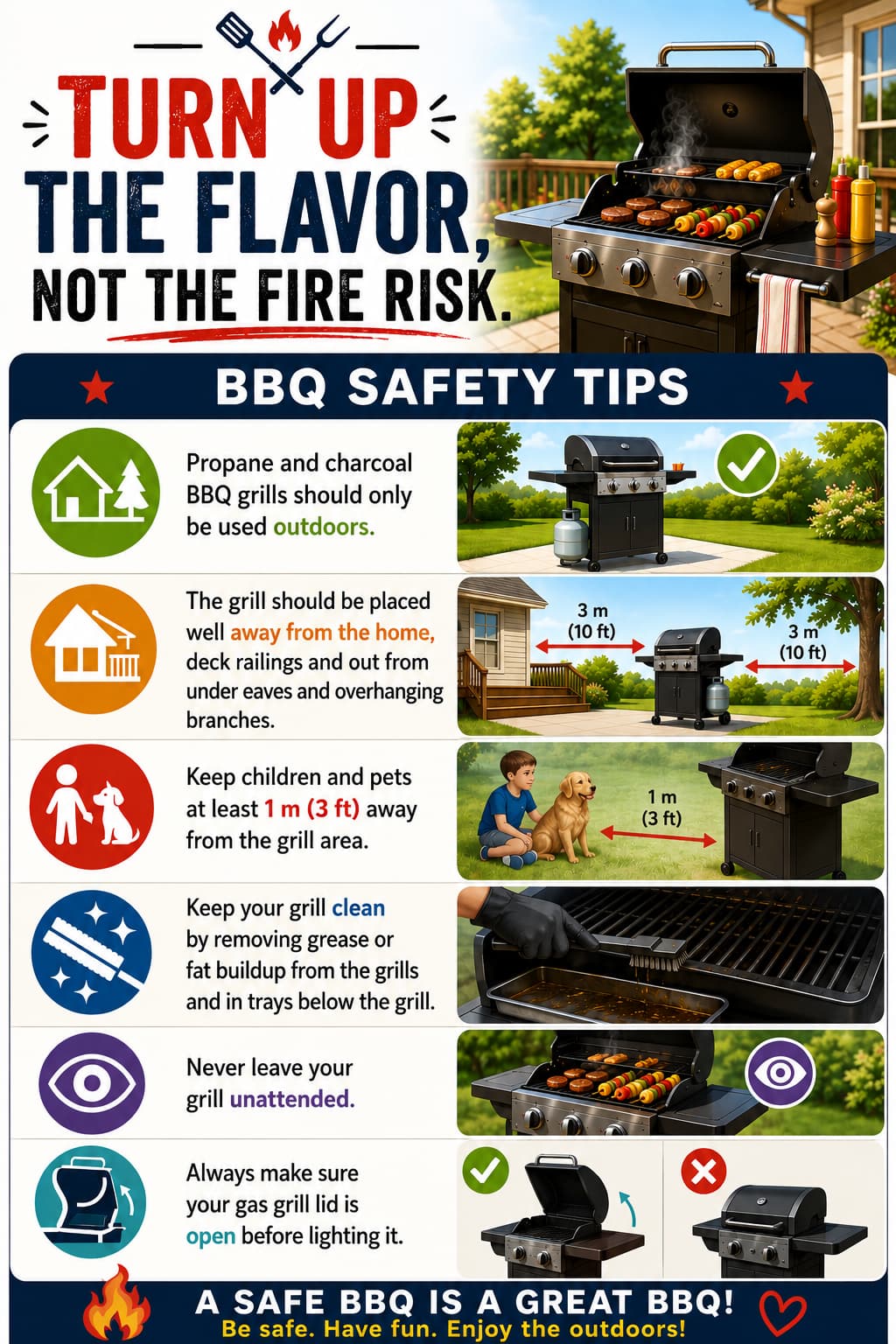
- Use propane and charcoal grills outdoors only.
- Place the grill 3 m (10 ft) from the home, railings and overhanging branches.
- Keep children and pets at least 1 m (3 ft) from the grill area.
- Remove grease and fat buildup so it can't catch fire.
- Never leave a lit grill unattended.
- Always open the gas lid before lighting.
Heading outdoors: keep it fire safe
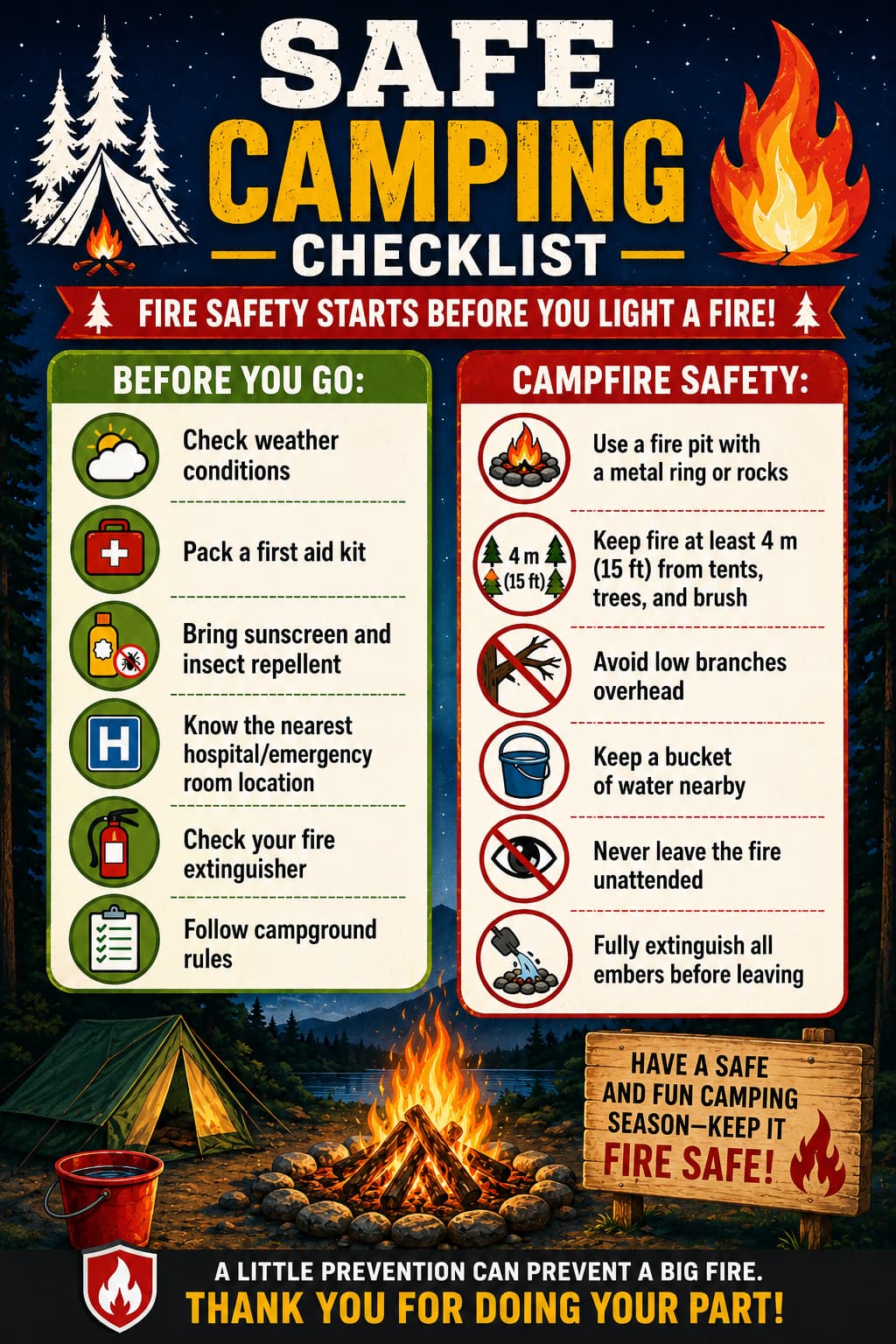
- Use a fire pit with a metal ring or rocks.
- Keep your fire at least 4 m (15 ft) from tents, trees and brush.
- Avoid low branches overhead and keep a bucket of water nearby.
- Never leave a fire unattended.
- Fully extinguish all embers before you leave — drown, stir, and drown again.
Fire safety at home
Open any topic to read more.
Smoke alarms
Most deaths from house fires happen at night, while people are sleeping. Working smoke alarms give you the warning you need to get out in time.
Where to put them
- Install alarms outside every sleeping area and on every level of the home, including the bottom of the basement stairs.
- If you sleep with the bedroom door closed, put an alarm inside the bedroom too.
Test and maintain
- Test every month — press and hold the button until the alarm sounds.
- Change the battery at least once a year. An easy reminder: change your clock, change your battery.
- Replace any alarm over 10 years old, or any unit without a test button.
- Clean alarms twice a year: wipe the cover and gently vacuum the sensor. A chirping alarm usually needs a new battery or a cleaning.
- Hard-wired alarms still need a backup battery for power outages, and should be installed by a qualified electrician.
Home fire escape planning
A fire can fill a home with smoke in minutes. Planning and practising your escape takes the panic out of those minutes and can save lives.
- Find two ways out of every room — usually a door and a window.
- Make sure windows and screens open easily and any security bars have a quick-release.
- Pick a meeting place outside, a safe distance from the home (a tree, a lamppost, the end of the driveway).
- Once you are out, stay out. Never go back inside for belongings or pets.
- Call 911 from outside — a neighbour's phone or your cell.
- Practise the plan twice a year, including once at night, so everyone (children included) knows what to do.
Cooking safety
Cooking is the leading cause of home fires. A pot of oil on a hot element can overheat and burst into flames in seconds.
- Stay in the kitchen when you fry, grill or broil. If you must leave, turn the burner off.
- Keep dish towels, packaging, curtains and loose sleeves away from the stove.
- Turn pot handles inward so they can't be knocked or grabbed.
- Heat oil slowly and watch for smoke — smoking oil is about to ignite, so turn down the heat.
If a pan catches fire
- Slide a lid over the pan and turn off the heat. Leave the lid on until it is fully cool.
- Never use water on a grease fire — it throws the flames outward.
- If the fire grows or you are unsure, get out and call 911.
Home heating
Heating is one of the leading causes of home fires in the colder months — and most are preventable.
- Keep anything that can burn (furniture, curtains, bedding, paper) at least 1 m (3 ft) from space heaters, stoves and fireplaces.
- Plug space heaters directly into the wall, never into an extension cord or power bar, and turn them off when you leave the room or go to sleep.
- Have furnaces, wood stoves and chimneys inspected and cleaned every year by a qualified professional.
- Store ashes in a metal container with a lid, kept outside and away from the home.
- Install a carbon monoxide alarm near sleeping areas if you burn any fuel (wood, oil, gas or propane).
Smoking — a fire hazard
Careless smoking remains one of the leading causes of fatal home fires. A smouldering cigarette can ignite hours after it is set down.
- Smoke outside. It is the single most effective way to prevent a smoking-related home fire.
- Use a deep, sturdy ashtray on a stable surface, away from anything that can burn.
- Soak butts and ashes in water before throwing them out — never empty an ashtray straight into the garbage.
- Never smoke in bed, when drowsy, or where medical oxygen is in use.
- Keep lighters and matches up high, out of children's reach.
Fire extinguishers
A portable extinguisher is for small, contained fires only. For general home use, keep a multi-purpose ABC extinguisher near an exit, in plain view, out of children's reach, and away from the stove.
Remember PASS
- P — Pull the pin.
- A — Aim low, at the base of the fire.
- S — Squeeze the handle.
- S — Sweep from side to side.
Fight or flight?
- Before you fight a fire: get everyone out and call 911 first.
- Only fight a fire that is small and contained, with a clear, unobstructed exit behind you.
- If you can't put it out almost immediately, leave it to the professionals — get out and stay out.
Know your classes of fire
- Class A — wood, paper, cloth, rubber.
- Class B — flammable liquids and gases, grease, oil-based paint.
- Class C — electrical equipment and appliances.
- Class D — combustible metals (rare in the home).
Maintenance
- Monthly: check the pressure gauge is in the green; rock dry-powder units gently so the powder doesn't compact.
- Yearly: have it serviced by a qualified technician and hydrostatically tested on the date shown on the tag.
- Recharge or replace after any use, even a short one. Never paint an extinguisher.
Just for kids and families
Fire safety is easier when the whole family practises together. Teach children to:
- Recognize the sound of the smoke alarm and know it means "get outside."
- Get low and go under smoke, and never hide during a fire.
- Stop, drop and roll if their clothes ever catch fire.
- Know the family meeting place and how to call 911 from a safe spot.
- Treat matches and lighters as tools for adults only — and tell a grown-up if they find some.
Want a firefighter to visit your school, daycare or community group? We deliver public education and school programs — contact us below to arrange a visit.
Contact the Bathurst Fire Department
Emergencies: call 911.
For fire prevention questions, smoke alarm help, station tours, school and group visits, inspections, or open-air burning in the city:
- Bathurst Fire Station #1 (administrative headquarters): 256 St. Andrew Street, Bathurst NB, E2A 1C4
- Telephone: (506) 548-0439
- Fax: (506) 549-3299
- Email: Fire@Bathurst.ca
- Open-air burning and permits: Burning Regulations and Permits (By-law 2017-09)
The seasonal posters and some safety information on this page are produced by or adapted from the Office of the Fire Marshal, Government of New Brunswick.